Holland and Zwarte Piet

Before coming to Holland I recall in my youth my mother used to play St. Nick for us on or around the 6th of December. We would put our shoes out somewhere – we didn’t have a fireplace.  In the morning ‘St. Nick’ had deposited some candy into them. We didn't get much into the tradition or storytelling aspect – we were more of a Christmas and Santa Claus family – like the rest of the US.

During my recent visit to Holland I witnessed the phenomenon of St. Nicholas as practiced by the Dutch. The tradition of St. Nicholas started here, more or less. I know it has roots in other countries as well but Holland really takes the cake for the way in which its delivers a certain pomp and spectacle along with it.

My first day in the small town of Doetinchem I was wandering around the town’s commercial center, it’s really just a square with a church and a bunch of stores surrounding it.  I came across these things at first:

_DSF1459.jpg
_DSF1507.jpg

Later with a bit more walking I came across a full fledged boy – he was no older than a teenage years maybe 16 or 17. He was dressed completely in blackface – this character they call Zwarte Piet, or Black Pete in English. I asked him if I could take his photo – he complied. I did not question him further. I was however extremely curious about what the Dutch currently think about this issue. Another part to the legend is that this Black Pete is St. Nick’s helper who has gone down the chimney to deliver presents. How exactly would his skin be totally and completely covered with soot and completely unrecognizable. How would his hair turn curly and also his lips bright red. What is the coincidentally implication of a black helper of santa vs. a white helper.

_DSF1461.jpg
_DSF1631.jpg
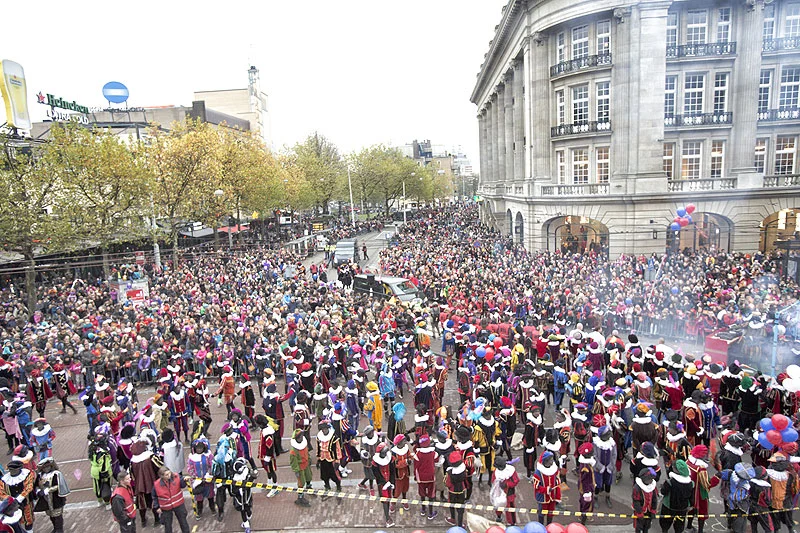
Pics of the 500 people dressed up on Nov 17. This photo is sourced from http://www.sintinamsterdam.nl/kinderen/fotos/ the documentation of the holidays festivities.

Pics of the 500 people dressed up on Nov 17. This photo is sourced from http://www.sintinamsterdam.nl/kinderen/fotos/ the documentation of the holidays festivities.

From what I gathered from talking to people about it was that a majority of Dutch who had been born and raised there don’t really seem to mind so much about the over racism being practiced. In fact they don’t see it as being racist at all. They say that this is their tradition. And that they have been practicing it for years and should be allowed to do so. Others I spoke with, though a slight minority do understand the implications of what is happening. They see the fact that a white European is putting on black paint, basically on all parts of the showing skin, as well as a curly black wig, and bright red lipstick. They do realize there is something more to this practice than fun and games with children and candy.

I had read around that time that there were people speaking out about this practice.  During the night that I spent in Amsterdam we came across a protest of black pete by African migrants and refugees. Again I did not get too far into the march, or do any reportage. The vibe I got was pretty real though. People are right to raise concerns. I’m not sure of their overall motive or argument but at least an argument is coming forth.

A good argument would be what if the boy was white. Some renditions, though scarce show the character as the same figure more or less but with no makeup just some smudges of soot on the face. This to me is way more accurate a depiction of what someone would look like had they gone down a chimney.

If you read the history of Holland and Belgium and understand their relationship to Africa you know that this entire practice is extremely problematic and needs a serious look and discussion around it. No matter if slavery was abolished 100 years ago, that history of violence and oppression remains, and it hurts even worse when you put a comic and friendly spin on it in the way that Zwarte Piet has.

Last day in Amsterdam

Stayed with Neal for the night my last night in town. He was renting a flat from a couchsurf he had previously been with. He got it for the month and will find another solution after that. Neil is originally from Scotland and has just made the move to Amsterdam. Asher and Michael met him when they stayed in Scotland and the UK for a few months earlier this year.

Pics from Neal's flat:

The beer we were drinking.

The beer we were drinking.

Nice color palette.

Nice color palette.

_DSF1911.jpg

Next day walked with asher around town. We went to Vondel Park, Asher found a guitar in the bushes. I was perfect because we had been talking about him needing a guitar and he wants to start playing on the street.

Asher and his guitar on a canal.

Asher and his guitar on a canal.

View from Neils's. Bit different than the small tight streets and canals I had gotten accustomed to.

View from Neils's. Bit different than the small tight streets and canals I had gotten accustomed to.

_DSF1948.jpg
_DSF1950.jpg
Vondelpark

Vondelpark

I wanted to see one of the original Dutch West India Company's buildings. It's around the Jordaan neighborhood of the city. I'm sure there are other buildings remaining yet this was the only one that I came across though. You can actually rent it out and have events here. It's so weird to see what the legacy of colonialism has become.

This is one of the buildings that was apart of the Dutch West India company's empire.

This is one of the buildings that was apart of the Dutch West India company's empire.

I then met Merjin at the Bibliotech a friend of Faiza who I had met in London. We had tea and some small food. He had been living in The Sudan for a while doing work now he is working in a refugee education center working as a teacher in Holland.

_DSF1985.jpg

Afterwards went back to Neil’s place via Sloterdijk.

_DSF1987.jpg

Grabbed stuff and headed for Zeeburg – little did I know that Zeeburg did not handle Eurolines busses. I quicky had to get a cab to Amstel station. Luckily there was one around, who know exactly the way and we made it with about a minute to spare. I was nearly about to wait for the bus to get to the station. Knowingly, if I had missed the bus I would have spent less on getting the station but definitely wasted time on rebooking and a wasted day not being in berlin.

I'm starting to understand that when you travel you sort of have to make decisions about the way in which you spend money and how you spend it. For example I could have said yea ok Ill take the bus and try and make it or spend more and take cab and sort of insure that I'll be there. There's also this same kind of idea when you travel cheaply. Pay for the cheapest ticket and sit around in layovers for an extended period or pay more and fly directly. What is 10-20 hours of your life worth really?

Shout out to the Ibrahim the Turkish cabbie.

</amsterdam> Ill post one last one about the Zwarte Piet thing though.

</amsterdam> Ill post one last one about the Zwarte Piet thing though.

Windmills and the klompen

The day that I left Doetinchem we drove around to see a few Holland specific sites, namely windmills and the traditional shoemaking method that is for me really associated with The Netherlands. 

You can spot many windmills when driving around the Dutch countryside. The windmills serve a few purposes, in current day they are mostly used to grind grains into power for the making of bread and other foodstuffs. In older times they were used to pump quite a bit of water out of the land back into the sea. The Dutch 'reclaimed' much land for the use of agriculture and living space in this method. They then built many dikes and dams to keep that water out.

The first stop was a windmill about 30km from Doetinchem.

_MG_0247.jpg
Tools used to sharpen the mill.

Tools used to sharpen the mill.

The wind moves the sails outside which spins this great cog that then spins the gears which mash up all of the harvested grains that are fed inside.

The wind moves the sails outside which spins this great cog that then spins the gears which mash up all of the harvested grains that are fed inside.

Dude doesn't look that happy but he was actually pretty jovial.

Dude doesn't look that happy but he was actually pretty jovial.

Where the mashed up grain comes out.

Where the mashed up grain comes out.

This was actually a windmill in a different location.

This was actually a windmill in a different location.

After the windmill I wanted to check out the methods of Dutch klompen - or in English its commonly referred to as clogs. We went a bit farther away from Doetinchem and came across this guy who's family has been making these shoes for hundreds of years. They are really practical for use in farming and working in the fields. They keep your feet elevated and dry, off of the mud and watery ground. 

This guy is fitting a strap to the shoe - there are two styles. One that sort of covers the whole foot and this one which is a bit easier to wear and not as tight on the foot. The thing about the shoes is that they won't ever really break in - as th…

This guy is fitting a strap to the shoe - there are two styles. One that sort of covers the whole foot and this one which is a bit easier to wear and not as tight on the foot. The thing about the shoes is that they won't ever really break in - as their made of completely of wood.

The process begins here literally with a block of wood.

The process begins here literally with a block of wood.

The wood is inserted on a series of machining devices which carve out parts. The final step is to size the shoes. The machine here fits a sample shoe into the vice and the two shoes on the outside match the size of the inside.

The wood is inserted on a series of machining devices which carve out parts. The final step is to size the shoes. The machine here fits a sample shoe into the vice and the two shoes on the outside match the size of the inside.

Here are some finished samples.

Here are some finished samples.